
 en
enCall me back
Please leave your phonenumber and we will call you as soon as possible.
- Quality equipment
- Skilled personnel
- Worldwide delivery
- Since 1977
- All
- Chicory (26)
- Vegetables (680)
- Fruits (530)
- Leafy vegetables (457)
- Tomatoes (311)
- Potplants (285)
- Tree nursery (280)
- Peppers (271)
- Herbs (269)
- Potatoes (216)
- Onions (209)
- Apples (202)
- Flower bulbs (201)
- Citrus and lemons (169)
- Eggplant (167)
- Zucchini (156)
- Brussels sprouts (154)
- Cucumbers (151)
- Avocados (150)
- Carrots (146)
- Pears (139)
- Recycling (134)
- Flowers (132)
- Food (132)
- Strawberries (119)
- Cherries (119)
- Trays (114)
- Kiwis (113)
- Lettuce (107)
- Broccoli (98)
- Leek (97)
- Mangoes (81)
- Peaches (80)
- Perennials (80)
- Asparagus (74)
- Mushrooms (69)
- Cabbage (67)
- Apricots (65)
- Summerflowers (55)
- Cauliflower (52)
- Oranges (52)
- Plums (47)
- Fennel (47)
- Radish (45)
- (Red) Beets (44)
- Tulips (43)
- Sweet potatoes (39)
- Sunflowers (38)
- Endive (38)
- Berries (35)
- Pumpkin (33)
- Spinach (33)
- Nectarines (32)
- Spring onions (29)
- Garlic (25)
- Grapes (23)
- Beans (22)
- Roses (21)
- Melons (20)
- Parsley (18)
- Gingers (15)
- Corn (15)
- Parsnip (14)
- Celery (12)
- Lilies (10)
- Peonies (9)
- Kale (9)
- Grains (8)
- Orchids (7)
- Chrysanthemums (6)
- Turnips (6)
- Celeriac (6)
- Phalaenopsis (5)
- Seeds (4)
- Freesias (3)
- French fries (3)
- Bok choy (1)
- Pickles (1)
- Show more (78)Show less
- All
- Hill formers (5)
- Flow pack machines (5)
- Top seal packaging machines (2)
- Pneumatic sowing machines (2)
- Forklifts (2)
- Inter row cultivators (1)
- Cultivators (1)
- Spading machines (1)
- Planting line (1)
- Receiving hoppers (1)
- Elevator incline conveyors (1)
- Roller sorting machines (1)
- Stairs (1)
- Trailers (1)
- Harvesting trolleys and trailers (1)
- Weed burners (1)
- Turntables (1)
- Show more (9)Show less
Be the first to receive new additional machines in your mailbox with any of the following features.
![AVR RSF 2000 4X75 hill former 4 x 75 cm, with stainless steel hill formers]()
AVR RSF 2000 4X75 hill former 4 x 75 cm, with stainless steel hill formers
![AVR RSF 2000 4X75 hill former 4 x 75 cm, with stainless steel hill formers]()
AVR RSF 2000 4X75 hill former 4 x 75 cm, with stainless steel hill formers
![Grimme GF400 hill former 4 x 75 cm, with stainless steel hill formers]() Sold under reservation
Sold under reservationGrimme GF400 hill former 4 x 75 cm, with stainless steel hill formers
![Ulma PV-350 flow pack machine with long infeed conveyor]()
Ulma PV-350 flow pack machine with long infeed conveyor
![Imants 37SX 300 DKH spading machine 300 cm with rake roller]()
Imants 37SX 300 DKH spading machine 300 cm with rake roller
![Ulma PV-350 flow pack machine]()
Ulma PV-350 flow pack machine
![Ulma Sienna LS BI flow pack machine with long infeed conveyor]() Sold under reservation
Sold under reservationUlma Sienna LS BI flow pack machine with long infeed conveyor
![Struik 4RF/310 hill former 4 x 75 cm]()
Struik 4RF/310 hill former 4 x 75 cm
![Van den Berg roller sorting machine 3+1 sortings]() Sold under reservation
Sold under reservationVan den Berg roller sorting machine 3+1 sortings
![Evers cultivator 3 teeth subsoiler]()
Evers cultivator 3 teeth subsoiler
![Kverneland Accord Miniair S pneumatic sowing machine 12 rows hydraulicly foldable]()
Kverneland Accord Miniair S pneumatic sowing machine 12 rows hydraulicly foldable
![Elevator incline conveyor 290 x 25 cm]()
Elevator incline conveyor 290 x 25 cm
![Vanhoucke THBR3000 weed burner 300 cm]()
Vanhoucke THBR3000 weed burner 300 cm
![G. Mondini E 350 VG top seal packaging machine with denester]()
G. Mondini E 350 VG top seal packaging machine with denester
![G. Mondini E 350 VG top seal packaging machine wit denester]()
G. Mondini E 350 VG top seal packaging machine wit denester
![Monosem MS pneumatic sowing machine 6 rows]()
Monosem MS pneumatic sowing machine 6 rows
![Fraxinus Codius Dema chicory infeed line / planting line with hopper]()
Fraxinus Codius Dema chicory infeed line / planting line with hopper
![Stainless steel staircase/ladder with handrail]()
Stainless steel staircase/ladder with handrail
![Prins PFD15 A forklift diesel 1500 kg.]() Sold under reservation
Sold under reservationPrins PFD15 A forklift diesel 1500 kg.
![Gielis Hoeing machine 6 rows ,7 elements]()
Gielis Hoeing machine 6 rows ,7 elements
![RGD VR-6 Genio flow pack machine for loose fragile products like zucchini and eggplant]()
RGD VR-6 Genio flow pack machine for loose fragile products like zucchini and eggplant
![Nissan LPG 15 automat forklift]()
Nissan LPG 15 automat forklift
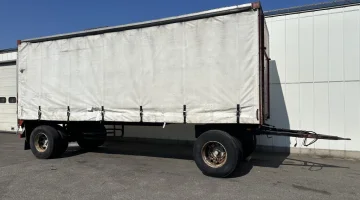
![Harvesting trailer 735 x 245 cm, 20 ton]()
Harvesting trailer 735 x 245 cm, 20 ton
![Record Scorpion flow pack machine]()
Record Scorpion flow pack machine
![Turntable new, 150 cm PP top]()
Turntable new, 150 cm PP top
![AVR GE-FORCE FARMER 4X75 hill former]() Sold under reservation
Sold under reservationAVR GE-FORCE FARMER 4X75 hill former
.jpg?resolution=360x200&quality=85&type=webp)
.jpg?resolution=360x200&quality=85&type=webp)
.jpg?resolution=360x200&quality=85&type=webp)
.jpg?resolution=360x200&quality=85&type=webp)
.jpg?resolution=360x200&quality=85&type=webp)
.jpg?resolution=360x200&quality=85&type=webp)
.jpg?resolution=360x200&quality=85&type=webp)
.jpg?resolution=360x200&quality=85&type=webp)
.jpg?resolution=360x200&quality=85&type=webp)
.jpg?resolution=360x200&quality=85&type=webp)
.jpg?resolution=360x200&quality=85&type=webp)
.jpg?resolution=360x200&quality=85&type=webp)
.jpg?resolution=360x200&quality=85&type=webp)
.jpg?resolution=360x200&quality=85&type=webp)
.jpg?resolution=360x200&quality=85&type=webp)
.png?resolution=360x200&quality=85&type=webp)
.jpg?resolution=360x200&quality=85&type=webp)
.jpg?resolution=360x200&quality=85&type=webp)
.jpg?resolution=360x200&quality=85&type=webp)
.jpg?resolution=360x200&quality=85&type=webp)
.jpg?resolution=360x200&quality=85&type=webp)
.jpg?resolution=360x200&quality=85&type=webp)
.jpg?resolution=360x200&quality=85&type=webp)
- Quality equipment
- Skilled personnel
- Worldwide delivery
- Since 1977
Got a machine for sale?
We are constantly looking for good quality agricultural and horticultural machinery.

About second-hand machines for Chicory
Witloof cultivation — also known in Belgium as chicory cultivation — is a specialized crop production consisting of two strictly separated phases: the field cultivation of witloof roots and the controlled forcing of witloof heads in a dark environment. Each phase imposes specific requirements on mechanization, product handling, and logistics. Duijndam Machines has practical experience in both root cultivation and the processing and forcing phase, and offers a targeted range of used machines for efficient and profitable witloof production.
On this page, you will find all machines for witloof cultivation that we currently have in stock. Interested in one of our machines? On the page of a specific machine, you will find detailed information, specifications, photos, and sometimes videos. If you still have questions, please contact us, so one of our advisors can determine together with you which witloof machine is suitable for your needs!
Phase 1: Mechanization of Witloof Root Cultivation (Field)
The quality of the final witloof head starts with uniform, straight, and healthy witloof roots. Accurate soil preparation, sowing techniques, and harvesting are decisive here.
Soil Preparation and Ridge Construction
Witloof is grown on raised ridges to promote straight root growth and uniform diameter. A stable, homogeneous soil structure prevents branching and deviations in the root. Depending on soil type and conditions, the following are used:
- Tine cultivators for intensive crumbling,
- Rotary hoes for a level and fine seedbed,
- Ridge formers or ridge plows for building uniform cultivation ridges.
Accurate ridge construction not only ensures optimal growth conditions but also simplifies the later harvesting process.
Precision Sowing of Witloof Roots
The sowing phase largely determines the final grading and yield. Pneumatic seeders are used to place the seeds at the exact depth and with a constant plant distance on the ridges. Often, a planting distance of 15 to 20 cm is maintained for witloof.
Uniform emergence results in:
✅ Equal root diameters,
✅ Less loss,
✅ More consistent quality in the forcing phase.
Precision sowing is therefore a direct investment in yield security.
Foliage Cutting and Harvesting
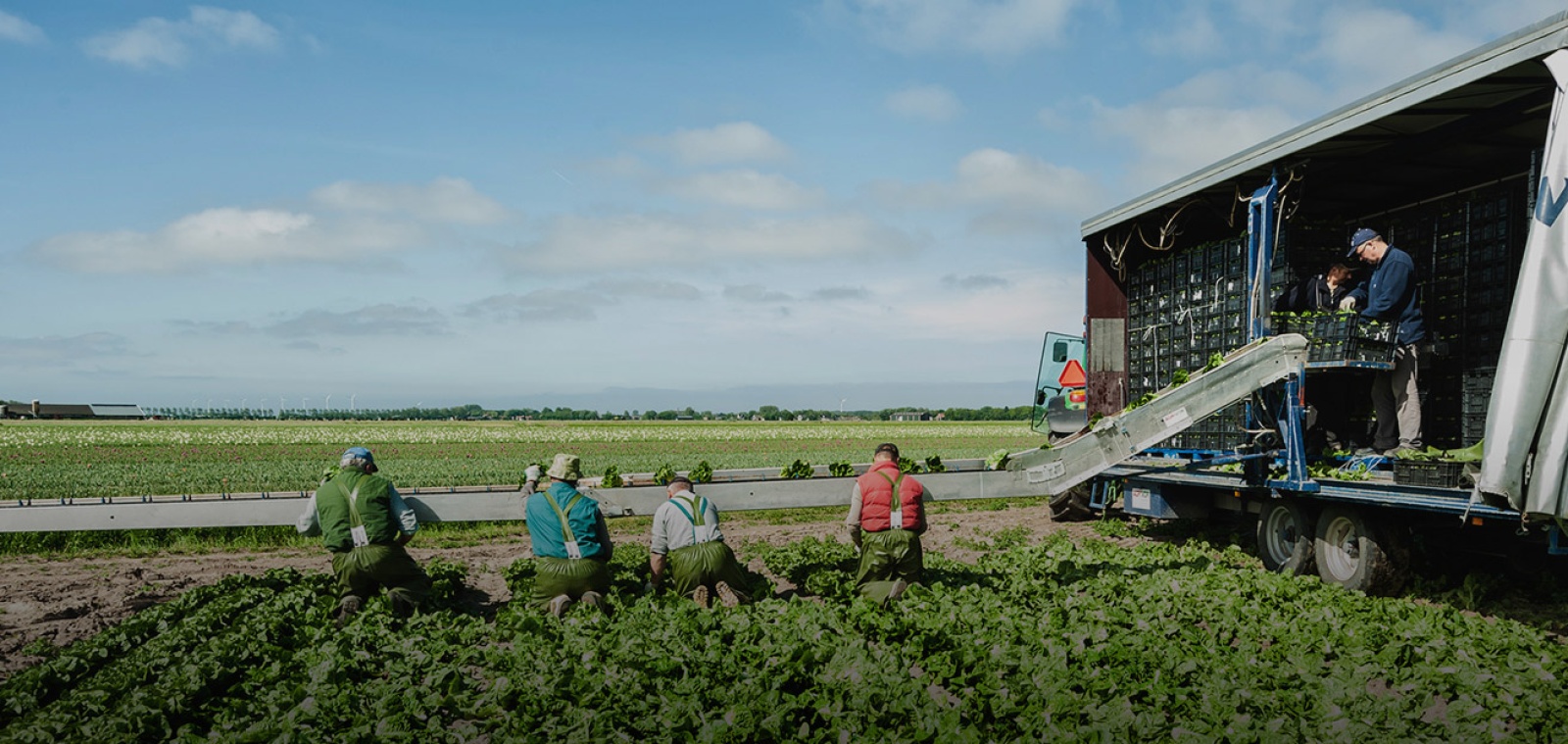
During mechanical harvesting, the foliage is cut by the machine before lifting the roots. This prevents blockages in the harvester and minimizes root damage. Harvesters with sieve belts lift the witloof roots from the ridge and cut them underground, separating excess soil immediately, after which the roots can be transported to the location where they will be further processed. Careful harvesting is essential to prevent quality loss during storage and forcing.
Sorting of Witloof Roots
After harvesting, the roots are sorted by diameter using roller sorting machines. Proper calibration is crucial: the root diameter directly affects the size and uniformity of the witloof head.
The wider the rollers, the higher the capacity per hour. Efficient sorting optimizes the loading of forcing trays and increases predictability of the final product.
Phase 2: Forcing and Processing of Witloof
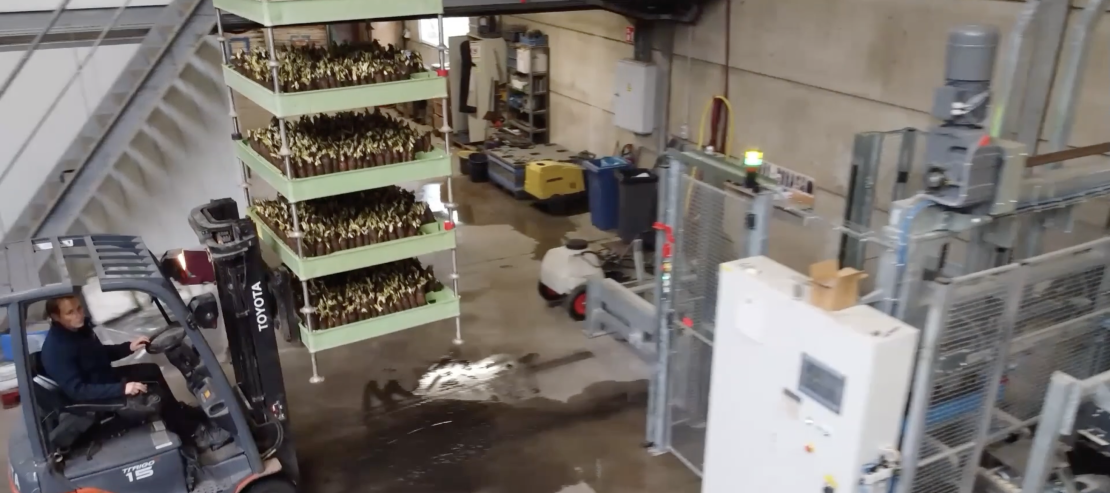
The second phase takes place in completely darkened rooms where temperature, humidity, and water supply are controlled. Here, the witloof roots are placed in forcing trays to develop heads (forcing). In this phase, logistical efficiency is decisive for the cost per head.
Processing Lines for Witloof Roots and Forcing Trays
An automated or semi-automated processing line can consist of:
- Stackers for empty trays,
- Dosing or feeding hoppers for witloof roots,
- Ergonomic planting stations for inserting roots,
- Stackers for filled forcing trays,
- Washing systems for cleaning trays.
Integrating these processes creates a continuous product flow with fewer manual operations, higher capacity, and better labor efficiency. Especially for larger volumes, mechanization can yield significant returns.
Witloof Cutting Machines
After the forcing phase, the witloof head is separated from the root. Professional witloof cutting machines are designed for precise and reproducible cuts. The cutting process:
- The operator places the root with head in a fixed position,
- Clamping elements secure the root,
- A rotating round knife separates the head from the root in a controlled manner.
A constant cutting height prevents quality loss and minimizes waste. After cutting, the outer leaves are manually or mechanically removed to obtain a market-ready head.
Packaging of Witloof
Witloof is sold both individually and in multiple consumer packs. Checkweighers can be integrated to achieve the desired sale weight accurately. Two commonly used packaging solutions are:
- Flow-pack machines with flat infeed conveyor, suitable for packaging without trays,
- Stretch or elastic film machines, for example, those from Waldyssa.
The choice of packaging line depends on the target market, retail requirements, and desired presentation.
Investing in Mechanization within Witloof Cultivation
As healthy food becomes increasingly important, and witloof is a very healthy crop, the market is growing. It may therefore be interesting to enter this cultivation. In witloof cultivation, labor forms a substantial part of the cost price.
Targeted investments in mechanization can lead to:
✅ Lower labor costs per unit,
✅ Higher processing capacity,
✅ Better product uniformity,
✅ Consistent quality towards retail.
Duijndam Machines supplies used witloof machines for both field cultivation and the processing phase of witloof. Thanks to experience within this specialized sector, we provide advice on technical solutions that align with your capacity, business setup, and market strategy.
Frequently asked questions about Chicory
How are chicory roots sorted?
Roller sorting machines sort roots by diameter. Wider rollers increase capacity and ensure uniform quality.
What packaging options are available for chicory?
Flowpack machines and stretch film packaging machines are commonly used. Weighing systems can control package weight.
Which chicory machine types does Duijndam Machines offer?
We supply used machines for chicory growers, including harvesters, cutting machines, and packaging systems from well-known manufacturers.
How are chicory roots sorted?
Roller sorting machines sort roots by diameter. Wider rollers increase capacity and ensure uniform quality.
What is the difference between chicory roots and chicory heads?
Chicory roots are grown in the field; chicory heads develop from the roots during dark forcing.