
 en
enCall me back
Please leave your phonenumber and we will call you as soon as possible.
- Quality equipment
- Personalised machine advice
- Worldwide delivery
- Since 1977
- All
- Ventilators (10)
- Elevator incline conveyors (9)
- Potato sorting machines (8)
- Weighing machine (7)
- Box tippers (6)
- Receiving hoppers (6)
- Brushing machines (4)
- Shovel containers (3)
- Sorting machines for flower bulbs and Brussels sprouts (3)
- Telescope conveyors (3)
- Sewing machine (3)
- Washing machines for vegetables (3)
- Store loaders (2)
- Dosing hoppers (2)
- Mobile elevator conveyor (2)
- Flat conveyors (1)
- Box turners (1)
- Hedgehog belts (1)
- Roller inspection conveyors (1)
- Destacking machines (1)
- Stacking machines (1)
- Box fillers (1)
- Big bag fillers (1)
- Potting machines (1)
- Soil bunkers (1)
- Show more (17)Show less
- All
- Agrodust (1)
- Asselbergs (3)
- Bijlsma Hercules (4)
- Botman (1)
- Climax (1)
- Compas (3)
- Delignie (2)
- Demtec (1)
- Devette (1)
- Euro-Jabelmann (1)
- Flauw (1)
- Grimme (1)
- Jako (1)
- Keulmac (1)
- Klima (7)
- Lockwood (1)
- MFP (1)
- Miedema (4)
- Mountec (1)
- Newlong (1)
- Offringa (1)
- Oldenhuis & Prinsen (2)
- Samon (1)
- Schouten (2)
- Spinnekop (2)
- Tong-Peal (1)
- Union (2)
- Visser Bolsward (4)
- Webo (1)
- Wifo (2)
- Show more (22)Show less
- All
- Potatoes (58)
- Onions (54)
- Carrots (36)
- Flower bulbs (25)
- (Red) Beets (16)
- Brussels sprouts (16)
- Recycling (14)
- Vegetables (11)
- Grains (7)
- Chicory (6)
- Fruits (5)
- Pumpkin (4)
- Leafy vegetables (4)
- Parsnip (4)
- Potplants (4)
- Perennials (3)
- Sweet potatoes (3)
- Mushrooms (2)
- Tree nursery (2)
- Mangoes (1)
- Cabbage (1)
- Apples (1)
- Oranges (1)
- Avocados (1)
- Broccoli (1)
- Flowers (1)
- Show more (18)Show less
Be the first to receive new additional machines in your mailbox with any of the following features.
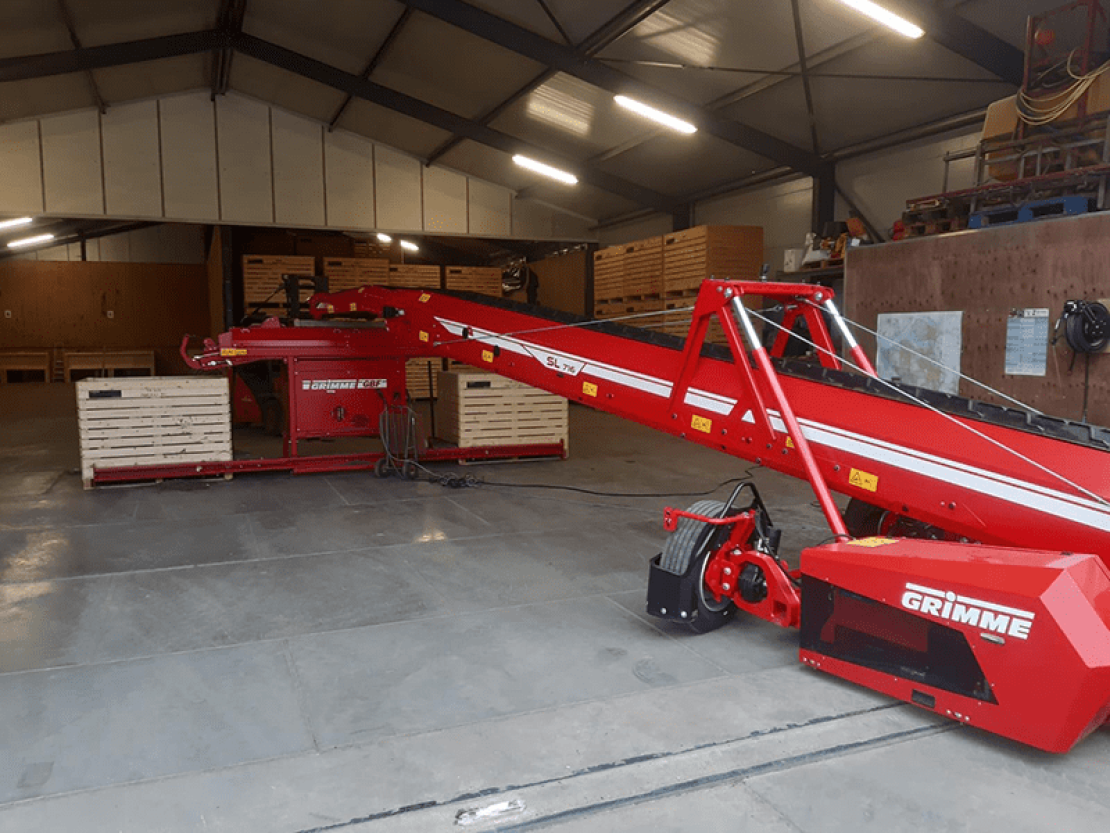
![Miedema TAT 161/70 telescopic conveyor]()
Miedema TAT 161/70 telescopic conveyor
![Demtec Gregoire soil bunker on wheels]()
Demtec Gregoire soil bunker on wheels
![Agrodust BBBV big bag filler]()
Agrodust BBBV big bag filler
![Miedema SB55 receiving hopper 200 cm bottom width]()
Miedema SB55 receiving hopper 200 cm bottom width
![Visser Bolsward KB store loader 1250 x 65 cm]()
Visser Bolsward KB store loader 1250 x 65 cm
![Visser Bolsward elevator incline conveyor 600 x 50 cm]()
Visser Bolsward elevator incline conveyor 600 x 50 cm
![Visser Bolsward receiving hopper with roller cleaning unit for potatoes]()
Visser Bolsward receiving hopper with roller cleaning unit for potatoes
![Spinnekop telescopic conveyor 1500 x 80 cm]()
Spinnekop telescopic conveyor 1500 x 80 cm
![Miedema SB651 receiving hopper]()
Miedema SB651 receiving hopper
![Tong-Peal weighing machine stainless steel]()
Tong-Peal weighing machine stainless steel
![Grimme TC80-16 telescopic conveyor]()
Grimme TC80-16 telescopic conveyor
![Klima ventilator 2,2 kW]()
Klima ventilator 2,2 kW
![Klima ventilator 2,2 kW]()
Klima ventilator 2,2 kW
![Klima ventilator 2,2 kW]()
Klima ventilator 2,2 kW
![Wifo HOD-Z-250+RVS/Spec shovel container 250 cm, with stainless steel bottom]()
Wifo HOD-Z-250+RVS/Spec shovel container 250 cm, with stainless steel bottom
![Schouten sorting machine for flower bulbs and Brussels sprouts step grader with 5 sortings]()
Schouten sorting machine for flower bulbs and Brussels sprouts step grader with 5 sortings
![Mountec MKV-2 box filler with elevating conveyor]()
Mountec MKV-2 box filler with elevating conveyor
![Asselbergs ventilator 70 cm 1,5 kw]()
Asselbergs ventilator 70 cm 1,5 kw
![Klima ventilator 2.2 kW 90 cm diameter]()
Klima ventilator 2.2 kW 90 cm diameter
![Asselbergs ventilator 2,2 Kw 90 cm]()
Asselbergs ventilator 2,2 Kw 90 cm
![Klima ventilator 2.2 kW 80 cm diameter]()
Klima ventilator 2.2 kW 80 cm diameter
![Klima ventilator 80 cm approx 1,8 KW]()
Klima ventilator 80 cm approx 1,8 KW
![Asselbergs ventilator 2,2 KW 80 cm]()
Asselbergs ventilator 2,2 KW 80 cm
![Miedema SB 1151 RZ receiving hopper]()
Miedema SB 1151 RZ receiving hopper
![Devette destacking machine for Danish trolleys, in- and output on other sides]()
Devette destacking machine for Danish trolleys, in- and output on other sides
![Klima DLM 8 NA ventilator 1.5 kW 80 cm]() Sold under reservation
Sold under reservationKlima DLM 8 NA ventilator 1.5 kW 80 cm
![MFP LMJ100 hedgehog belt Haulm separator for potatoes, onions and root crops]()
MFP LMJ100 hedgehog belt Haulm separator for potatoes, onions and root crops
![Offringa Rotator 1600 box turner for potatoes 160 cm with unloading function]()
Offringa Rotator 1600 box turner for potatoes 160 cm with unloading function
![Compas LD8EB7 sorting machine for flower bulbs and Brussels sprouts]()
Compas LD8EB7 sorting machine for flower bulbs and Brussels sprouts
![Oldenhuis & Prinsen Keulmac Unicum EHKK box tipper 160 cm]()
Oldenhuis & Prinsen Keulmac Unicum EHKK box tipper 160 cm
.jpg?resolution=360x200&quality=85&type=webp)
.jpg?resolution=360x200&quality=85&type=webp)
.jpg?resolution=360x200&quality=85&type=webp)
.jpg?resolution=360x200&quality=85&type=webp)
.jpg?resolution=360x200&quality=85&type=webp)
.jpg?resolution=360x200&quality=85&type=webp)
.jpg?resolution=360x200&quality=85&type=webp)
.jpg?resolution=360x200&quality=85&type=webp)
.jpg?resolution=360x200&quality=85&type=webp)
.jpg?resolution=360x200&quality=85&type=webp)
.jpg?resolution=360x200&quality=85&type=webp)
.jpg?resolution=360x200&quality=85&type=webp)
.jpg?resolution=360x200&quality=85&type=webp)
.jpg?resolution=360x200&quality=85&type=webp)
.jpg?resolution=360x200&quality=85&type=webp)
.jpg?resolution=360x200&quality=85&type=webp)
.jpg?resolution=360x200&quality=85&type=webp)
.jpg?resolution=360x200&quality=85&type=webp)
.jpg?resolution=360x200&quality=85&type=webp)
.jpg?resolution=360x200&quality=85&type=webp)
.jpg?resolution=360x200&quality=85&type=webp)
.jpg?resolution=360x200&quality=85&type=webp)
.jpg?resolution=360x200&quality=85&type=webp)
.jpg?resolution=360x200&quality=85&type=webp)
.jpg?resolution=360x200&quality=85&type=webp)
.jpg?resolution=360x200&quality=85&type=webp)
.jpg?resolution=360x200&quality=85&type=webp)
- Quality equipment
- Personalised machine advice
- Worldwide delivery
- Since 1977
Got a machine for sale?
We are constantly looking for good quality agricultural and horticultural machinery.


About second-hand Storage
During storage intake, the harvest comes from the field or from the transport trailer into the barn, where it is processed, sorted or stored. For potatoes, onions, carrots and flower bulbs, careful handling is essential at this stage: the product needs to move from one machine to the next with as little damage as possible, often at a fairly high pace. Duijndam Machines has a changing range of used storage intake machines that keep this process running smoothly, from elevator conveyors and receiving hoppers to box tippers, box fillers and store loaders.
Which machines fall under storage intake?
Under the category storage intake fall several types of machines, each with its own role in the process from field to barn. Elevator conveyors and conveyor belts move the product upward or transfer it between machines. Receiving hoppers catch the product and dose it evenly through to the rest of the line. Box tippers gently tip out crates or pallet boxes so the product can be processed or sorted further. Box fillers and store loaders do the reverse: they fill crates or a storage building with the sorted product in a product-friendly way. Below, we go through the benefits and key points to watch for per machine group when buying.
Benefits of used storage intake machines
A used storage intake machine requires a lower investment than a new one and, because it's delivered from stock, usually reaches the yard faster than when you have a new machine built. This shortens the payback period, which also makes a secondhand machine attractive when you only need it for part of the year, for instance during the seasonal peak around harvest. Most storage intake machines are also based on simple, robust and proven technology that's not prone to breakdowns, and they fit well into an existing line. So you don't have to replace the whole intake line just to improve one link in it. Finally, reusing machines is simply a more sustainable choice than always producing new ones.
Key points to check with used machines
With a used storage intake machine, it's mainly important to check whether the machine is in good technical condition and whether it fits within the existing intake line. First, check whether the machine suits your product, whether that's potatoes, onions, carrots or flower bulbs, and whether its capacity matches the rest of the line: a machine that's undersized or oversized quickly becomes the bottleneck. Also pay attention to practical dimensions such as belt width, infeed height and discharge height, and to the drop heights between machines; excessive drop heights are a common cause of product damage. A product-friendly design, for example with drop breakers or gentle transitions between machine parts, often makes the difference. Practical matters count too: is the machine mobile or easy to fit into the desired spot, is the electrical connection suitable (usually 400V), do the emergency stops and safety guards work properly, and are parts still available or easy to replace if needed?
Points to check per machine group
Elevator conveyors and conveyor belts
With a used elevator conveyor or conveyor belt, it's mainly about the right length, belt width and maximum discharge height for the line, and about the type of belt: a flat belt or a cleated belt, depending on the product and the angle at which you want to elevate it. Check the condition of the belt itself, the rollers, the bearings and the drive, and check whether the belt has variable speed, which makes it easier to match capacity to the rest of the line. Aside from elevator conveyors, Duijndam Machines regularly also has a wider range of conveyor belts available.
Receiving hoppers
With a used receiving hopper, capacity and content are the key factors: does it match the volume of product you want to process per hour? Just as important is an even dosing to the next machine, so the line doesn't stall. Check the condition of the floor, the chains, the dosing rollers and the drivers, and check whether there's an option for tare removal, which saves cleaning further down the process.
Box tippers
A used box tipper first of all needs to suit the crate size and crate weight you work with. Pay attention to a gentle dosing of the product during tipping, and check the condition of the hydraulics, the cylinders, the pivot points and the crate clamping, as these are the parts that suffer most from intensive use. Also look at the drop height to the next machine, as this is one of the points in the line where product damage occurs.
Box fillers and store loaders
With a used box filler or store loader, the machine needs to match the crate size and/or the storage space, and filling needs to happen in a product-friendly way with a limited drop height. Check the condition of the belts, the swivel mechanism, the sensors and the adjustment options, and pay attention to the maximum discharge height and the reach of the machine. For store loaders specifically, a well-functioning telescopic belt and automation of the swivel movement are important points, as this determines how evenly the storage space is filled.
Ready-to-use storage intake machines
For the storage intake of potatoes, onions, carrots or flower bulbs, Duijndam Machines offers a changing range of secondhand elevator conveyors, receiving hoppers, box tippers, box fillers and store loaders, checked before they go on sale, at a lower investment and shorter delivery time than new. When choosing, pay particular attention to how well it matches your product and existing line, the drop heights and the condition of the key parts per machine group. Our machines can be viewed at our site in Nieuwerkerk aan den IJssel (Rotterdam region); we deliver worldwide, with extensive experience exporting to Europe, the Middle East and Asia.
Also check out our range of harvesting machines and conveyor belts for the rest of your line.
Frequently asked questions about Machines for storage
What exactly does bringing in the harvest involve?
Bringing in the harvest is the process of moving the crop, such as potatoes, onions, carrots or flower bulbs, from the field or transport trailer into the barn, where it is processed, sorted or stored.
Which machines fall under the category of machines for storage?
This category includes elevating conveyors and transport belts, dump hoppers and receiving bins, box tippers, and bin/hall fillers. Each machine has its own role in the process from field to barn.
Why would I choose a used machine for storage?
A used machine requires a lower investment, is often available directly from stock, and therefore has a shorter payback period. This also makes used equipment attractive if you only need a machine seasonally.
Is the electrical connection of these machines suitable for my business?
Most storage machines run on a 400V connection. Check this before purchase, along with the operation of emergency stops and safety systems.