
 en
enCall me back
Please leave your phonenumber and we will call you as soon as possible.
- Quality equipment
- Personalised machine advice
- Worldwide delivery
- Since 1977
- All
- Celery (15)
- Vegetables (670)
- Fruits (526)
- Leafy vegetables (469)
- Herbs (289)
- Tree nursery (273)
- Tomatoes (267)
- Potplants (264)
- Potatoes (223)
- Peppers (216)
- Onions (215)
- Apples (181)
- Flower bulbs (172)
- Food (160)
- Eggplant (159)
- Citrus and lemons (157)
- Carrots (155)
- Avocados (148)
- Zucchini (147)
- Brussels sprouts (140)
- Cucumbers (136)
- Flowers (133)
- Recycling (132)
- Lettuce (122)
- Pears (122)
- Cherries (120)
- Trays (113)
- Kiwis (110)
- Strawberries (104)
- Broccoli (88)
- Leek (88)
- Mangoes (86)
- Perennials (84)
- Asparagus (81)
- Cabbage (77)
- Peaches (76)
- Apricots (68)
- Mushrooms (62)
- Fennel (59)
- Cauliflower (58)
- Summerflowers (57)
- Berries (53)
- Endive (52)
- Radish (52)
- (Red) Beets (51)
- Tulips (43)
- Plums (41)
- Sunflowers (40)
- Oranges (40)
- Sweet potatoes (39)
- Spinach (38)
- Roses (38)
- Grapes (36)
- Chicory (32)
- Nectarines (31)
- Pumpkin (30)
- Beans (28)
- Spring onions (27)
- Garlic (22)
- Corn (21)
- Gingers (20)
- Parsley (19)
- Melons (19)
- Nuts (17)
- Parsnip (16)
- Chrysanthemums (15)
- Grains (15)
- Peonies (15)
- Lilies (13)
- Orchids (13)
- Phalaenopsis (10)
- Freesias (8)
- Kale (8)
- Celeriac (8)
- Turnips (7)
- Bok choy (5)
- Seeds (4)
- French fries (3)
- Meat (3)
- Pickles (3)
- Show more (80)Show less
Be the first to receive new additional machines in your mailbox with any of the following features.
.jpg?resolution=1110x0&background=FFFFFFFF&quality=85&force_jpg_crop=1)
![Ulma Sienna LS flow pack machine with supply conveyor]()
Ulma Sienna LS flow pack machine with supply conveyor
![Ulma PV-350 flow pack machine]() Sold under reservation
Sold under reservationUlma PV-350 flow pack machine
![Ulma PV-350 flow pack machine with long infeed conveyor]()
Ulma PV-350 flow pack machine with long infeed conveyor
![Ulma PV-350 flow pack machine]()
Ulma PV-350 flow pack machine
![Foodlogistik ShreddR classic 140 cutting machine for cubes, strips and slices]()
Foodlogistik ShreddR classic 140 cutting machine for cubes, strips and slices
![Ulma PV-350 LSHI flow pack machine with feeding conveyor]()
Ulma PV-350 LSHI flow pack machine with feeding conveyor
![Imants 32SC250 spading machine 250 cm]()
Imants 32SC250 spading machine 250 cm
![Record Scorpion flow pack machine]()
Record Scorpion flow pack machine
![Kronen GS-10 cutting machine with 5 knives and trolley]()
Kronen GS-10 cutting machine with 5 knives and trolley
![Roller conveyor stainless steel 910 x 40 cm]()
Roller conveyor stainless steel 910 x 40 cm
![Stainless steel staircase/ladder with handrail]()
Stainless steel staircase/ladder with handrail
![Baekelandt harvester for celeriac]()
Baekelandt harvester for celeriac
![Kronen GS10 cutting machine With stainless steel cutting table]()
Kronen GS10 cutting machine With stainless steel cutting table
![Harvesting trailer 735 x 245 cm, 20 ton]()
Harvesting trailer 735 x 245 cm, 20 ton
![New custom made harvesting conveyor]()
New custom made harvesting conveyor
.jpg?resolution=360x200&quality=85&type=webp)
.jpeg?resolution=360x200&quality=85&type=webp)
.jpg?resolution=360x200&quality=85&type=webp)
.jpg?resolution=360x200&quality=85&type=webp)
.jpg?resolution=360x200&quality=85&type=webp)
.jpg?resolution=360x200&quality=85&type=webp)
.jpg?resolution=360x200&quality=85&type=webp)
.jpg?resolution=360x200&quality=85&type=webp)
.jpg?resolution=360x200&quality=85&type=webp)
.jpg?resolution=360x200&quality=85&type=webp)
.jpg?resolution=360x200&quality=85&type=webp)
.jpg?resolution=360x200&quality=85&type=webp)
- Quality equipment
- Personalised machine advice
- Worldwide delivery
- Since 1977
Got a machine for sale?
We are constantly looking for good quality agricultural and horticultural machinery.


About second-hand machines for Celery
Celery is a demanding crop that requires specific machines from harvesting in the field to washing, cutting and packaging for sale. Duijndam Machines has a varying supply of used machines for the cultivation and processing of celery, from proven manufacturers such as Ortomec, Hortech and Joper.
Whether you are looking for a second-hand celery harvester, a washing line or a cutting and packaging machine: at Duijndam Machines you will find well-inspected machines that are ready to deploy quickly. Our machines can be viewed at our premises and are delivered worldwide.
Celery cultivation in the Netherlands and Europe
The Netherlands is one of the most important producers of blanched celery in Europe. Cultivation takes place mainly on light sandy clay and clay soils that drain well. The growing season generally runs from April to November, with early crops being started under plastic tunnels to extend the harvest period.
Alongside Dutch cultivation, Spain, Italy and the United Kingdom have large-scale production of blanched celery for the European market.
Demand for efficient harvesting and processing machines is increasing, partly because labour costs are rising and the availability of seasonal workers is under pressure. Mechanised processing offers growing businesses the opportunity to scale up capacity without proportionally increasing staff numbers.
From harvest to sale: the celery processing process
Harvesting and processing celery – and in particular blanched celery – follows a fixed number of steps. Each step requires the right machine to limit quality loss and guarantee efficient throughput.
Planting
Celery cultivation often begins with transplanting young plants. Vegetable planting machines ensure even plant spacing and efficient planting over large areas. During the growing phase, hoeing machines, soil cultivation machines and other technical cultivation solutions can be deployed to keep the soil in optimal condition and support crop development.
Harvesting
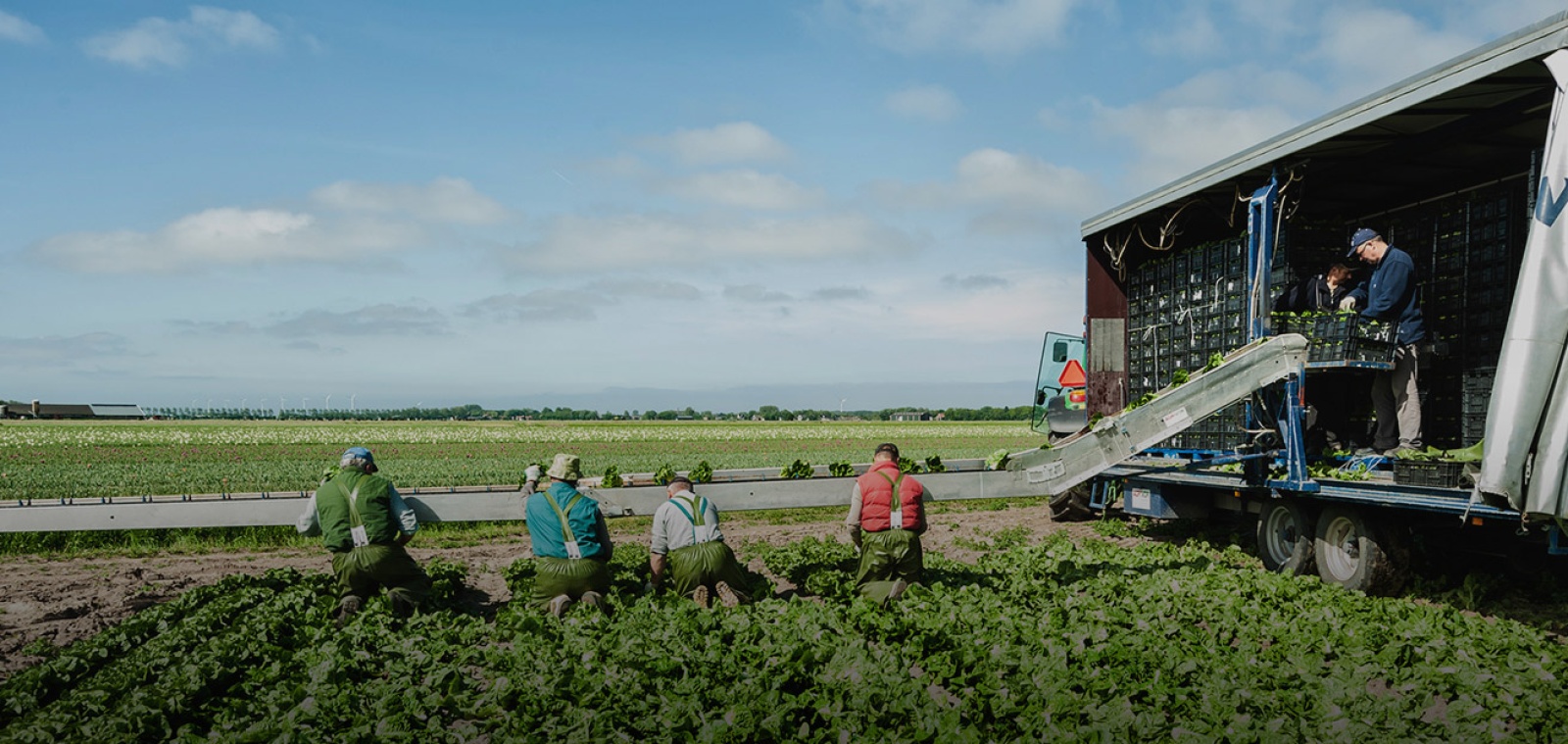
The harvesting machine determines the capacity and quality of the harvest. Used celery harvesters are available as single-row or multi-row variants, self-propelled or trailed. When purchasing a used harvesting machine, the condition of the cutting unit, the transport mechanism and the hydraulic drive are of great importance.
Self-propelled harvesting machines are more manoeuvrable in the field and require less external traction, but demand a larger maintenance budget due to their own engine and driveline. Trailed harvesting machines are generally simpler in construction and cheaper to purchase and maintain, but are dependent on a tractor with sufficient horsepower and hydraulic capacity.
Washing lines and cooling for celery
After harvesting, celery is washed to remove soil, dirt and any crop protection residues. A pass-through washing machine or hydrocooler rinses the stalks thoroughly clean while the product is simultaneously cooled for a longer shelf life. Good cooling immediately after harvesting is essential to preserve the freshness and crispness of the stalks.
A complete washing line for celery generally consists of the following components:
- Pre-cleaner: removes coarse dirt and caked soil from the stalks before the actual washing unit
- Washing unit: intensive washing with water and brushes or water curtains that clean the surface thoroughly
- Hydrocooler (optional): rapidly cools the product back to storage temperature by immersing or rinsing with cold water
- Dryer/blower line: removes excess water from the product, so it is immediately suitable for packaging
The capacity of a washing line for celery varies from a few hundred to more than a thousand heads per hour, depending on the configuration and throughput speed. When buying a used washing line, the condition of the pumps, spray nozzles, brushes and the drainage system is of great importance.
Trimming and cutting
Celery stalks are trimmed: excess leaves and the bottom of the head are removed to the desired presentation length. This can be done manually or via an automatic trimming and cutting machine, depending on the scale of processing. A uniform cutting length is a requirement for retailers and foodservice customers. Trimming celery is labour-intensive when done manually. An automatic trimming line takes over this work and delivers a uniform end product, with less dependence on manual personnel. The machine cuts the celery to size and removes excess leaves using rotating knives or cutting discs.
The precise setting of the cutting machine is important: cutting too short leads to loss of saleable product, while cutting too long does not meet the requirements of the retail customer. Modern trimming machines have adjustable cutting positions with which the presentation length can be determined accurately.
Sorting; Sorting machines for celery
After trimming, celery is sorted by weight or size. Retail demands uniform heads, while foodservice and industry apply different specifications. An accurate sorter reduces waste and increases the yield per harvested hectare. For celery, sorting is usually by weight, with different weight classes depending on the destination:
Class | Weight | Destination |
Small | 300–500 g | Foodservice, small packaging |
Medium | 500–800 g | Retail supermarket |
Large | 800–1,200 g | Wholesale, export |
Industry | >1,200 g | Processing, soup and juice |
An accurate weight sorter automatically distributes the products to the correct class and leads them to the corresponding packaging line. This reduces labour, increases line speed and ensures a more consistent end product.
Packaging lines for celery
Sorted celery is packaged in film, nets or crates for transport to the customer. For retail packaging, flowpack machines or film machines are often used. Packaging protects the product against drying out and physical damage during transport and storage.
Film packaging (flowpack): Blanched celery is often offered in retail in shrink film or stretch film. This keeps the product fresh longer, counteracts drying out and the product is easily recognisable on the shelf. Flowpack machines pack the heads quickly and uniformly.
Nets or bands: For foodservice and wholesale, celery is sometimes bundled with elastic or packed in a net. This requires less material and is faster, but offers less protection.
Crates and pallet boxes: Unpackaged celery intended for the processing industry or wholesale is loosely filled into crates or pallet boxes. An automatic crate filler or pallet box filler speeds up this process and reduces quality loss from manual stacking.
Cooling and storage
After packaging, celery is stored in cooled rooms at a temperature of 0 to 2 degrees Celsius. Under optimal storage conditions, blanched celery keeps for four to eight weeks. A good palletising machine ensures an efficient and stable stacking arrangement in the cold store.
Why second-hand machines for celery?
New processing lines for celery require a substantial investment. Second-hand machines offer a cost-efficient route to professional processing, provided the machines have been properly inspected and maintained.
At Duijndam Machines, every machine is inspected by our own engineers. Defective parts are replaced and you receive clarity about the condition before purchase. This way you know exactly what you are purchasing, without surprises afterwards. Our supply changes regularly because we actively purchase machines from growing businesses that are renewing, scaling up or stopping.
Duijndam Machines delivers machines to dozens of countries worldwide. We have extensive experience with export to Europe, the Middle East, North Africa and Asia, and we guide transport and export documentation from start to finish. Contact us for the current availability of machines for celery.
Frequently asked questions about Celery
Which types of celery are most commonly processed by machine?
Celery (stalks for retail and foodservice) is the most common type for large-scale mechanical processing. Leaf celery is processed in smaller volumes and requires different machinery, particularly for cutting and packaging. Both crops have specific requirements regarding the settings of harvesting and processing equipment. If you are interested, please enquire about the suitability of a machine for your specific type of celery.
Is celery always harvested using machinery?
On smaller farms, celery is still regularly harvested by hand. Mechanical harvesters become economically viable once a certain area and daily output are reached. On larger farms, harvesters deliver significant savings on labour costs, reduce reliance on seasonal workers and speed up the turnaround time from field to cold store, which improves product quality.
How susceptible is celery to damage during processing?
Celery is a relatively delicate product. Bruising or cuts sustained during harvesting or processing quickly lead to browning and a loss of quality, which shortens the shelf life and reduces the sales value. It is therefore important that conveyor belts, guides and cutting units are correctly adjusted and free from sharp edges or excessive wear. At Duijndam Machines, wear parts are checked as standard during the inspection of every machine.
How does hydrocooling affect the shelf life of celery?
Hydrocooling rapidly cools celery immediately after harvest by rinsing or immersing the produce in cold water. This significantly slows down cellular respiration and considerably extends shelf life. For celery destined for fresh retail or export, hydrocooling is a common and effective step in the processing line. Without rapid cooling, celery loses a noticeable amount of its crispness and freshness within just a few hours of harvest.
Which machines are suitable for both celery and other leafy vegetables?
Some washing lines, cutting machines and sorting machines can be adjusted to handle a variety of leafy crops, such as leeks, fennel, parsley or spinach. The extent of this adaptability varies depending on the machine and manufacturer. Please contact us to discuss whether a specific machine is suitable for your crop portfolio, so that you can make the most of your investment across multiple crops or seasons.