
 en
enCall me back
Please leave your phonenumber and we will call you as soon as possible.
- Quality equipment
- Skilled personnel
- Worldwide delivery
- Since 1977
Be the first to receive new additional machines in your mailbox with any of the following features.
![Mulder harvesting trailer, 660 × 210 x 250 cm, 8 ton]()
Mulder harvesting trailer, 660 × 210 x 250 cm, 8 ton
![Pazzaglia FZ110 AV shrub and tree lifter]()
Pazzaglia FZ110 AV shrub and tree lifter
![Lauwers Borobos AL harvester for trees]()
Lauwers Borobos AL harvester for trees
![Basrijs BRS/D135 shaking bedlifter double 135 cm]()
Basrijs BRS/D135 shaking bedlifter double 135 cm
![Nobels 2B bedlifter]()
Nobels 2B bedlifter
![Elco SL3VBM shaking bedlifter 135 cm, with hydraulic depth adjustment]()
Elco SL3VBM shaking bedlifter 135 cm, with hydraulic depth adjustment
![Robot shrub and tree lifter]()
Robot shrub and tree lifter
![Schrauwen PL ECO 3 135 cm shaking bedlifter 135 cm]()
Schrauwen PL ECO 3 135 cm shaking bedlifter 135 cm
![Schrauwen PL ECO 3 135 cm shaking bedlifter]()
Schrauwen PL ECO 3 135 cm shaking bedlifter
![Schrauwen Combiro shrub and tree lifter 50 cm]()
Schrauwen Combiro shrub and tree lifter 50 cm
![Deman shrub and tree lifter 50 cm]()
Deman shrub and tree lifter 50 cm
![Schrauwen Combiro 2 shaking bedlifter]()
Schrauwen Combiro 2 shaking bedlifter
![Coenders Clamp belt harvester for roses with Rasspe binder]()
Coenders Clamp belt harvester for roses with Rasspe binder
![Dröppelmann SEL50 tree lifter 50 cm]() Sold under reservation
Sold under reservationDröppelmann SEL50 tree lifter 50 cm
![Schrauwen Rolinet netting machine for root balls]()
Schrauwen Rolinet netting machine for root balls
![Logitec DB-40 Big-Bale dosage bunker]()
Logitec DB-40 Big-Bale dosage bunker
![Basrijs 135 cm Double shaking bedlifter new]()
Basrijs 135 cm Double shaking bedlifter new
![Basrijs 135 cm single shaking bedlifter new]()
Basrijs 135 cm single shaking bedlifter new
![Logitec extension plates for DB-40 big-bale dosing bunker]()
Logitec extension plates for DB-40 big-bale dosing bunker
.jpg?resolution=360x200&quality=85&type=webp)
.jpg?resolution=360x200&quality=85&type=webp)
.jpg?resolution=360x200&quality=85&type=webp)
.jpg?resolution=360x200&quality=85&type=webp)
.jpg?resolution=360x200&quality=85&type=webp)
.jpg?resolution=360x200&quality=85&type=webp)
.jpg?resolution=360x200&quality=85&type=webp)
.jpg?resolution=360x200&quality=85&type=webp)
.jpg?resolution=360x200&quality=85&type=webp)
.jpg?resolution=360x200&quality=85&type=webp)
.jpg?resolution=360x200&quality=85&type=webp)
.jpg?resolution=360x200&quality=85&type=webp)
.jpg?resolution=360x200&quality=85&type=webp)
.jpg?resolution=360x200&quality=85&type=webp)
.jpg?resolution=360x200&quality=85&type=webp)
.jpg?resolution=360x200&quality=85&type=webp)
- Quality equipment
- Skilled personnel
- Worldwide delivery
- Since 1977
Got a machine for sale?
We are constantly looking for good quality agricultural and horticultural machinery.


About second-hand Harvesting machines
For lifting or harvesting vegetables, fruit and flowers and plants, a wide range of harvesting machines is available: automatic, self-propelled, tractor-trailed or operated with a crew on board. Which type suits you best depends heavily on the crop. When harvesting vegetables, the emphasis is usually on capacity: getting as much produce off the land in as little time as possible. With fruit and flowers, the emphasis is instead on preventing damage, since these products are more delicate and bruising or cuts quickly lead to a loss of value.
What should you look out for when choosing a harvesting machine?
A harvesting machine is a significant investment that you will often use for many years, so a well-considered choice pays off. Besides the crop itself, your cultivation system, compatibility with your tractor and the conditions on your fields all play a role in determining which machine best suits your business. Below are the main points to consider.
Crop suitability and flexibility
Most harvesters are designed to harvest one specific product. Some machines can be used more broadly: a carrot harvester, for example, can also be suitable for parsnips or beetroot, and a potato harvester can, with the right settings, also load onions. When selecting a machine, the key question is whether it is suitable for your crop, or whether it can be used more widely thanks to, for example, an adjustable row spacing or different blade and belt configurations for another product. The product's sensitivity to damage, such as bruising or cuts, also plays a role; most harvesting machines are already designed with this in mind.
Does the machine suit your cultivation system?
The harvesting machine needs to match the cultivation system used for the crop, such as the type of bed or ridge, the track width and the row spacing. It is also important that the machine fits into your existing logistics process after lifting, such as the size of your bulk bins or a bulk discharge into crates.
Compatibility and connection to the tractor
Most harvesters are attached to a tractor. Pay attention to the track width, the required horsepower, the hydraulics and the electrical couplings, so that the machine connects properly to your existing tractors.
Field conditions
Soil type is a determining factor when choosing a harvesting machine. On light sandy soil, clay or stony ground, a different type of machine may be better suited; clay soil, for example, often requires a different sieving or shaking system than light sandy soil. Lower weight is an advantage in terms of soil compaction. On small plots, manoeuvrability between the rows – for example thanks to steering wheels or axles – can be a clear advantage.
Harvesting in wet conditions
Autumn weather can bring challenges. If it rains heavily over a longer period, open-field vegetables such as potatoes, carrots, leeks, Brussels sprouts and cabbage are sometimes harvested in very wet conditions. Some harvesting machines are better equipped for this, for example with tracks or extra powered wheels. This type of drive can also offer advantages on hilly plots.
Own machine or contractor
A contractor is also regularly hired for harvesting. The advantage of owning your own machine is that you decide for yourself when and how the harvest takes place, without depending on a third party's schedule.
Harvesting machines per crop
There is a dedicated type of harvesting machine for almost every crop. Below is an overview of the most requested crops and the machines that go with them.
Potatoes and onions
For potatoes you use a potato harvester, often combined with a haulm topper to remove the foliage before lifting. For onions there are dedicated onion harvesters and onion-top toppers; as mentioned earlier, a potato harvester can sometimes also be used to load onions.
Carrots and other root vegetables
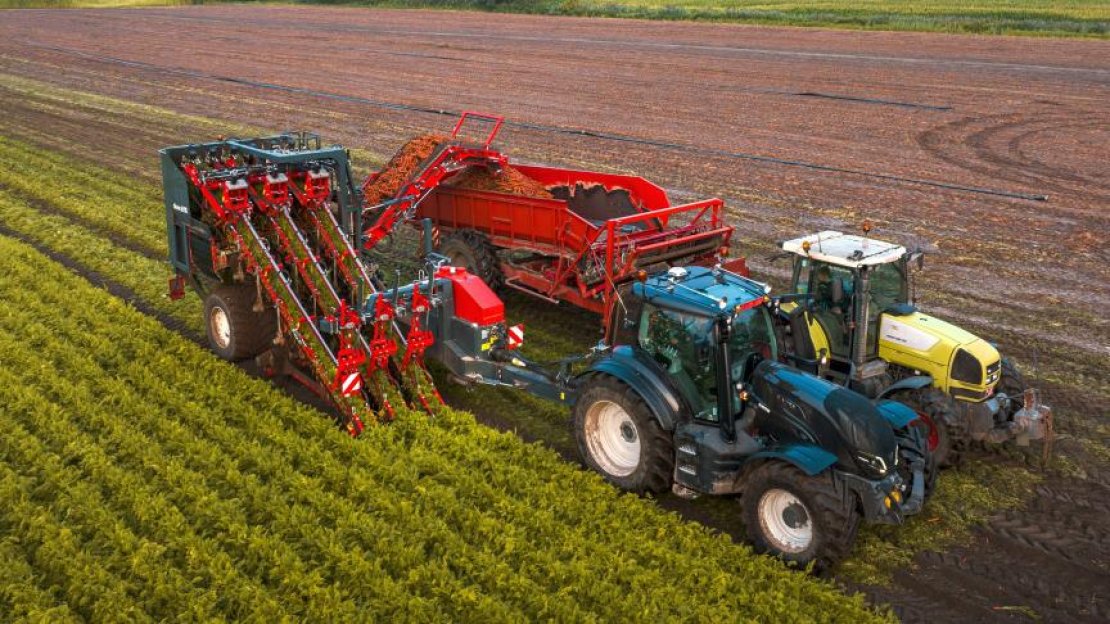
For carrots, parsnips and beetroot, a carrot harvester is generally used, thanks to this machine type's broader versatility. Similar lifting systems are available for celeriac and celery, often designed as a bed harvester.
Leeks
For leeks, a leek harvester is used, usually a clamp-belt harvester that pulls the leeks from the ground and discharges them directly into crates or onto a conveyor belt.
Cabbage, broccoli, cauliflower and Brussels sprouts
For cabbage, broccoli and cauliflower there are dedicated cabbage harvesters. For Brussels sprouts, a sprout picker is used, which picks the sprouts from the stem.
Lettuce, spinach and other leafy vegetables
For lettuce and other leafy vegetables there are lettuce harvesters, and for spinach there are dedicated spinach harvesters, often self-propelled so the crop is cut directly and gently.
Asparagus, beans, garlic and fennel
For harvesting asparagus there are harvesting aids that ease the cutting process. For beans there are bean pickers, for garlic there are garlic harvesters, and for fennel there are fennel harvesters, often designed as a clamp-belt harvester with automatic crate filling.
Tree nursery and shrubs
For the tree nursery there are shrub and tree lifting machines and clamp-belt harvesters for trees, often combined with a shaking bedlifter to loosen the root ball before it is lifted.
Fruit, such as strawberries
For soft fruit such as strawberries, the emphasis is strongly on preventing damage, which is why this harvest is often still done by hand or with supporting harvesting aids rather than fully automatic machines.
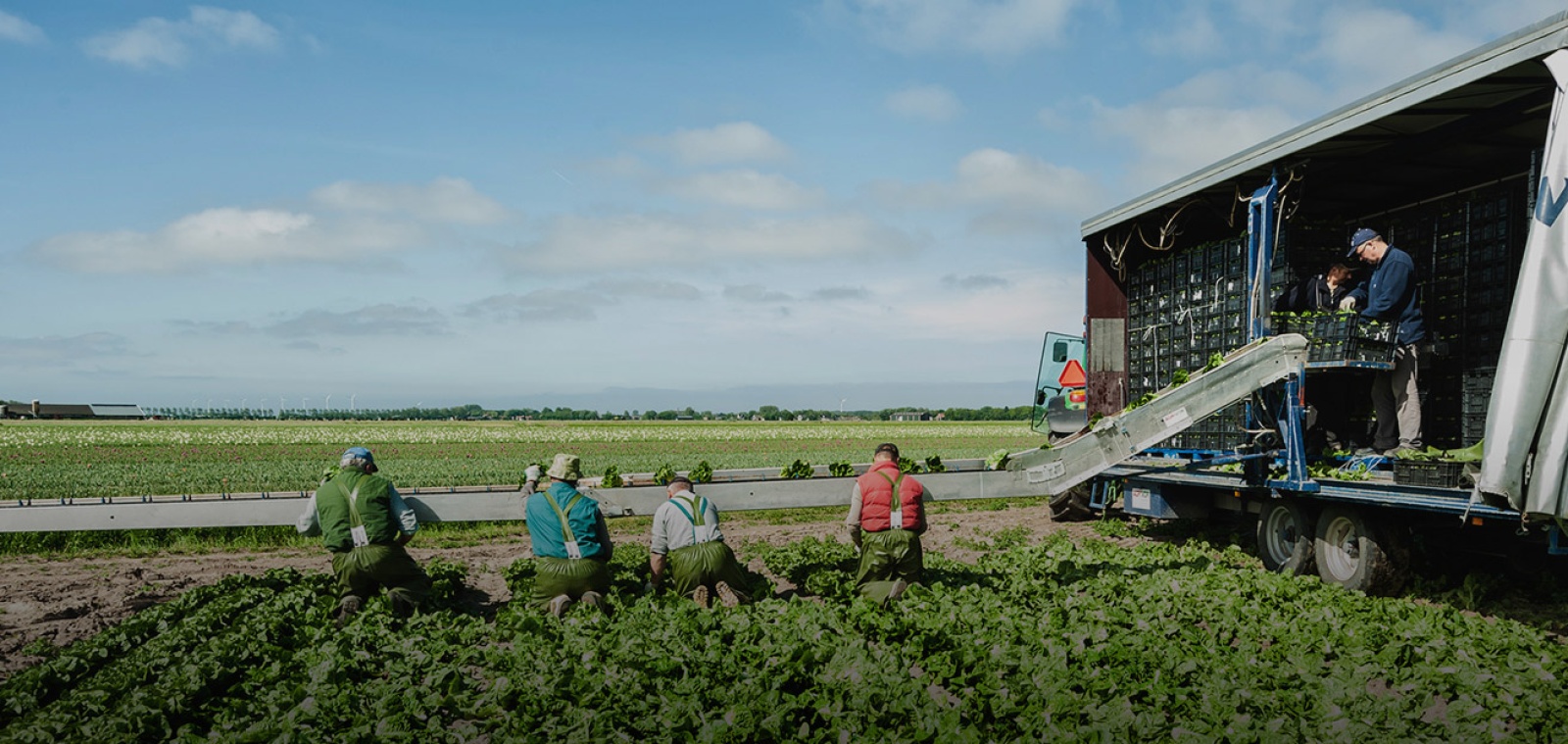
After lifting, the product is often discharged directly using a harvesting conveyor or harvest trailer, so that the process from lifting to storage runs smoothly.
Use the filters on this page to find the right machine, for example for a specific crop such as carrots, leeks, onions or asparagus, or machines such as leek harvesters, shaking bedlifters, potato harvesters, carrot harvesters or cabbage harvesters. Do you have questions or are you interested? Feel free to contact us for personal advice or a no-obligation quote.
Frequently asked questions about Harvesting Machines
What is the difference between a trailed and a self-propelled harvester?
A trailed harvester is hitched to a tractor and draws its power from it, while a self-propelled machine has its own engine and controls. Self-propelled machines are often more manoeuvrable and built for one specific task, whereas trailed machines are usually cheaper and can be used more flexibly with different tractors.
Can one harvester be used for multiple crops?
For some machines, yes. A carrot harvester, for example, can also be suitable for parsnips or beetroot, and a potato harvester can sometimes be adjusted to load onions as well. Other machines, such as a Brussels sprout harvester, are developed for one specific crop only.
Can the working depth be adjusted while driving?
On many modern harvesters, the working depth can be hydraulically adjusted while you're working, for example via the controls in the tractor cab. This is useful with varying soil conditions within a single field, such as transitions between lighter and heavier soil.
How do I prepare a used harvester for the season?
Before the season, check wear parts such as knives, rubber belts and sieve bars, lubricate the moving parts, and inspect the hydraulic hoses for leaks or wear. At Duijndam Machines, every used machine has already been inspected, cleaned and repaired where needed before sale, so you can get started almost straight away.
How much horsepower do I need to power a trailed harvester?
This varies greatly per machine and crop type: a light bed harvester requires considerably less power than a heavy multi-row potato harvester. Besides horsepower, your tractor's hydraulic capacity and number of electrical connections also determine compatibility. We're happy to advise you on which machine matches your tractor.